


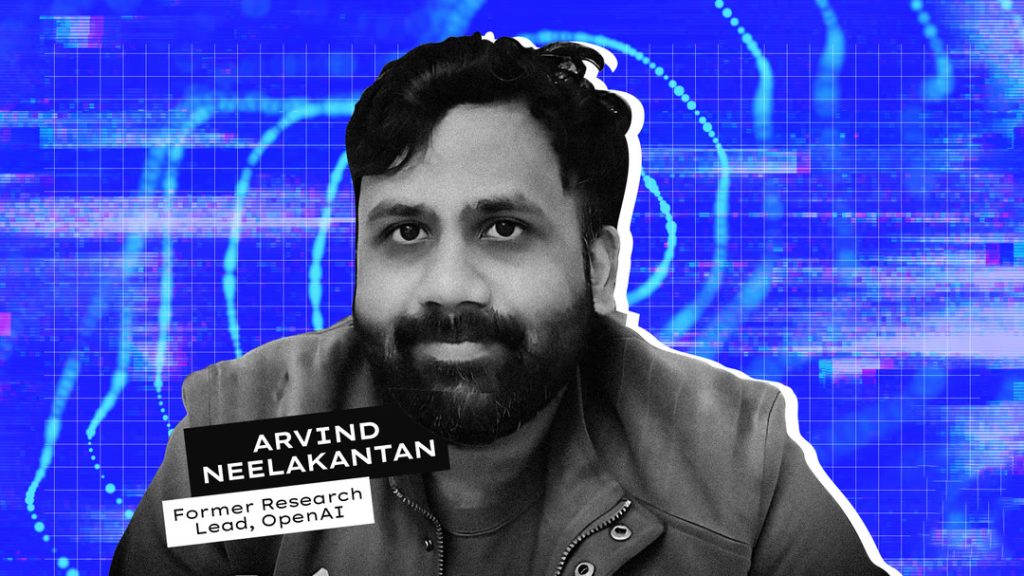
From classroom curiosity to a global AI revolution—Arvind Neelakantan’s journey behind GPT-3 and ChatGPT.
While ChatGPT’s global success seemed sudden, the technology behind it was long in the making. Arvind Neelakantan, an engineer born in Chennai, played a key role in building GPT-3—one of the foundational models that eventually led to the creation of ChatGPT. His work at OpenAI has helped shape the very core of modern conversational AI.
A product of top global institutions—including NIT Tiruchirappalli, Columbia University, and the University of Massachusetts Amherst—Neelakantan’s career has included research stints at Google Brain and Meta, before he took on the role of Research Lead at OpenAI. There, he spearheaded crucial machine learning and NLP projects central to GPT-3’s development.
Speaking recently at Scaler School of Technology’s “Inside the Mind of AI” session in Bengaluru, Neelakantan gave rare insights into how academic experiments evolved into global-scale innovation. “It’s just a lot of hard work,” he said, explaining how countless small tests laid the groundwork for what would become ChatGPT. “Deep learning is very empirical. You try a lot of things and see what works.”
From Chennai Classrooms to Silicon Valley Labs
Neelakantan’s journey began in Chennai, where a love for mathematics evolved into an early interest in programming. “I started liking the concept of expressing subjects procedurally through code,” he recalled. By his second year of undergrad, he was already assisting PhD students on research projects, developing a fascination for the power of foundational knowledge and technical breakthroughs.
“I liked the idea that something entirely new can emerge when you focus on a hard technical problem,” he said, reflecting on his growing interest in AI during a time when the field was far from mainstream.
Behind the Scenes at OpenAI
Discussing the shift from GPT-3 to ChatGPT, Neelakantan emphasized the importance of rapid iteration and technical precision. “Big things don’t look big in the beginning. They often seem chaotic. But with the right focus and belief, they evolve.”
He also stressed that AI is still in its early stages globally. While foundational models like GPT-3 and GPT-4 have set the stage, there’s much more to be explored—especially in areas like multi-modal learning and algorithmic innovation. For Indian researchers and startups, he advised focusing on core research that can yield practical, testable advancements.
Ethics, Hype, and the Human Element
Neelakantan acknowledged the growing importance of ethics in AI development. “Most organizations take it seriously. It’s often part of onboarding,” he noted, highlighting that social context is increasingly a part of building AI products.
On whether AI is entering a hype cycle, he said, “Maybe for some companies. But few technologies have changed the world as fast as this. There are still teams working under the radar—those will shine in the years to come.”
He also addressed concerns about over-reliance on AI, especially for younger engineers. “I use AI all the time—especially for coding. But without fundamentals, it can become a problem. We need to adapt how we learn and evaluate skills.”
What Lies Ahead for AI Research?
For researchers, Neelakantan said the opportunity has never been greater. “In 2012, we’d go to conferences and celebrate a 0.5% improvement on obscure datasets. Today, the entire world is your testbed. That’s amazing—but it also means it’s harder to do meaningful, long-term work with all the noise.”
On claims like those in Apple’s recent paper “The Illusion of Thinking”, he agreed that models are still far from perfect. “Yes, models make mistakes. But look at the pace of change. It’s astounding. The main story is not the flaws—it’s the direction we’re heading.”